math214:hw12
Differences
This shows you the differences between two versions of the page.
| Next revision | Previous revision | ||
|
math214:hw12 [2020/04/19 18:34] pzhou created |
math214:hw12 [2026/02/21 14:41] (current) |
||
|---|---|---|---|
| Line 10: | Line 10: | ||
| where | where | ||
| $$h_r(x,y) = r^{-2} e^{ - (x^2+y^2)/ | $$h_r(x,y) = r^{-2} e^{ - (x^2+y^2)/ | ||
| - | is a Guassian peak with radius $r$ and height $r^2$. Answer the following question without doing computation: | + | is a Guassian peak with radius $r$ and height $r^{-2}$. Answer the following question without doing computation: |
| - Let $p = (-1,0)$, $q = (1,0)$. As $r \to \infty$, how many geodesics are there between $p$ and $q$? | - Let $p = (-1,0)$, $q = (1,0)$. As $r \to \infty$, how many geodesics are there between $p$ and $q$? | ||
| - As $r \to 0$, how does the amount of geodesics between $p$ and $q$ changes? | - As $r \to 0$, how does the amount of geodesics between $p$ and $q$ changes? | ||
| - Is it possible that for any finite $r$, there are only finitely many geodesics between $p$ and $q$? | - Is it possible that for any finite $r$, there are only finitely many geodesics between $p$ and $q$? | ||
| + | |||
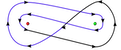
| + | Here is a picture, and the {{ : | ||
| + | {{ : | ||
| + | |||
| + | And here is a video: {{ : | ||
| 2. Let $S$ be the submanifold of $\R^3$, that arises as the graph of $x^2 - y^2$. Compute the second fundamental form of $S$ at $x=0, y=0$. | 2. Let $S$ be the submanifold of $\R^3$, that arises as the graph of $x^2 - y^2$. Compute the second fundamental form of $S$ at $x=0, y=0$. | ||
| 3. Let $G$ be a compact Lie group with a bi-invariant metric $\la -,- \ra$. Let $X, Y, Z$ be left-invariant vector fields. (try to do it yourself before checking Example 4.2.11 in [Ni]). Show that | 3. Let $G$ be a compact Lie group with a bi-invariant metric $\la -,- \ra$. Let $X, Y, Z$ be left-invariant vector fields. (try to do it yourself before checking Example 4.2.11 in [Ni]). Show that | ||
| - | $$ R(X, Y) Z = (1/4) [ [X, Y], Z] $$ | + | $$ R(X, Y) Z = (-1/4) [ [X, Y], Z] $$ |
| 4. (Cartan 3-form). Same setup as 3. There is $3$-form $B$ on $G$, satisfying | 4. (Cartan 3-form). Same setup as 3. There is $3$-form $B$ on $G$, satisfying | ||
| $$B(X, Y, Z) = \la [X, Y], Z \ra. $$ | $$B(X, Y, Z) = \la [X, Y], Z \ra. $$ | ||
| Show that this form is closed. In the case $G = SU(2) \cong S^3$, can you recognize this $3$-form as something familiar? | Show that this form is closed. In the case $G = SU(2) \cong S^3$, can you recognize this $3$-form as something familiar? | ||
| + | |||
| + | Hint: use the [[https:// | ||
| 5. (Normal Coordinate.) Ex 4.1.43. Hint: choose nice coordinate and nice basis. | 5. (Normal Coordinate.) Ex 4.1.43. Hint: choose nice coordinate and nice basis. | ||
math214/hw12.1587321243.txt.gz · Last modified: 2026/02/21 14:44 (external edit)
Page Tools
Except where otherwise noted, content on this wiki is licensed under the following license: CC Attribution-Share Alike 4.0 International


