math121b:03-20
Differences
This shows you the differences between two versions of the page.
| Next revision | Previous revision | ||
|
math121b:03-20 [2020/03/20 05:32] pzhou created |
math121b:03-20 [2026/02/21 14:41] (current) |
||
|---|---|---|---|
| Line 16: | Line 16: | ||
| We first look for critical points of $S(z)$, then we deform the contour so that they pass these critical points, then we control the directions that the contour passes through the critical point, to minimize the oscillation of the integrand, i.e choose the contour $C$ near the critical points, so that the integrand has constant phase. | We first look for critical points of $S(z)$, then we deform the contour so that they pass these critical points, then we control the directions that the contour passes through the critical point, to minimize the oscillation of the integrand, i.e choose the contour $C$ near the critical points, so that the integrand has constant phase. | ||
| + | |||
| + | And to leading order, we can replace $f(z)$ by its value at the critical point. | ||
| + | |||
| + | ** Example ** | ||
| + | Physicists ususally use $1/\hbar$ as $\lambda$. Here are some sample computation. | ||
| + | $$ \int_\R e^{-\frac{1}{\hbar} x^2/2} dx = \sqrt{2\pi \hbar} $$ | ||
| + | $$ \int_\R x e^{-\frac{1}{\hbar} x^2/2} dx = 0 $$ | ||
| + | $$ \int_\R x^2 e^{-\frac{1}{\hbar} x^2/2} dx = \hbar^{3/2} \int_\R u^2 e^{- u^2/2} du = \hbar^{3/2} \sqrt{2\pi} $$ | ||
| + | The point is that, having $x^2$ in the pre-factor will make the integral much smaller (indeed, the $x^2$ factor is killing the peak of $e^{-x^2/ | ||
| + | |||
| + | Another trick to compute the last equality is that | ||
| + | $$ \int_\R x^2 e^{- \lambda x^2/2} dx = -2 \frac{d}{d\lambda} \int_\R | ||
| ---- | ---- | ||
| Line 21: | Line 33: | ||
| Now, back to our Bessel function. We let $x/2$ be the large parameter $\lambda$. Then we have phase function | Now, back to our Bessel function. We let $x/2$ be the large parameter $\lambda$. Then we have phase function | ||
| $$ S(u) = u - 1/u. $$ | $$ S(u) = u - 1/u. $$ | ||
| - | - Critical points of $S(u)$. This is the place where $S' | + | - Critical points of $S(u)$. This is the place where $S' |
| - Massage our contour so that they pass through the critical point. Yes, it does, since our contour is the unit circle $|u|=1$. | - Massage our contour so that they pass through the critical point. Yes, it does, since our contour is the unit circle $|u|=1$. | ||
| - Make sure it passes the critical point in the 'right direction' | - Make sure it passes the critical point in the 'right direction' | ||
| - | - Consider the critical point $u_0=i$ first. For $u = u_0 + v$, we have | + | |
| - | $$ S(u_0 + v) \approx S(u_0) + (1/2) S'' | + | |
| - | The constant term is $2i$, we can do nothing about it, just leave it there. The quadratic term is $ - (i/2) v^2$. Recall $v = u - u_0$, as $u$ passes through $u_0$, $v$ passes through $0$. We want to choose the direction in which $v$ passes through $0$, so that $-(i/2) v^2$ remains real, and has a local maximum at $v=0$. So we parametrize $v = s e^{- i \pi /4}$, for $s$ real, that way | + | Consider the critical point $u_0=i$ first. For $$u = u_0 + v,$$ we have $$ S(u_0 + v) \approx S(u_0) + (1/2) S'' |
| - | $$ -(i/2) v^2 = - 1/2 s^2. $$ | + | |
| - | So the contour $C$ should passes through $i$, in the direction $3\pi/4$( or $-\pi/4$, depending on which way you look). | + | |
| + | Thus, the contribution for $u_0 = i$ is | ||
| + | $$ \begin{aligned} | ||
| + | I_1 & | ||
| + | & =(2\pi i)^{-1} (i)^{-1-n} e^{i x} \int_{+\infty}^{-\infty} e^{-(x/2) s^2} d [s e^{- i \pi /4}] \cr | ||
| + | & = (2\pi i)^{-1} (-1) (i)^{-1-n} e^{i x - i \pi /4} \int_{-\infty}^{+\infty} e^{-(x/2) s^2} ds \cr | ||
| + | & = (2\pi i)^{-1} (-1) e^{i x - i \pi /4 - (n+1) i \pi /2 } \sqrt{2\pi/ | ||
| + | \end{aligned} $$ | ||
| + | |||
| + | Similarly, we can compute the contribution at $u_0 = -i$, we get | ||
| + | $$ \begin{aligned} | ||
| + | I_2 & | ||
| + | & \approx (2\pi i)^{-1} (-i)^{-1-n} e^{-i x} \int_{-\infty}^{+\infty} e^{-(x/ | ||
| + | & \approx (2\pi i)^{-1} (-i)^{-1-n} e^{-i x + i \pi /4} \int_{-\infty}^{+\infty} e^{-(x/2) s^2} ds \cr | ||
| + | & \approx | ||
| + | \end{aligned} $$ | ||
| + | |||
| + | Finally, we can add up the two contributions to get | ||
| + | $$ J_n(x) \approx I_1 + I_2 = \sqrt{2/\pi x} \sin(- x + \pi /4 + (n+1) \pi /2) = \sqrt{2/\pi x} \cos(x - (2n+1) | ||
| + | where the last step uses trig identity $\sin(A) = \cos(\pi/2 - A)$, so that we agree with Boas. | ||
| + | |||
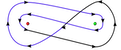
| + | Here is a picture of the 'ideal contour', | ||
| + | {{ : | ||
| + | It is made with [[https:// | ||
| + | |||
| + | |||
| + | |||
| + | ------ | ||
| + | |||
| + | This finishes Chapter 12. I did not talk about the Airy function, Hermite function, Laguerre functions. I will leave those | ||
| + | as reading materials, and post homework questions about them. | ||
math121b/03-20.1584682375.txt.gz · Last modified: 2026/02/21 14:44 (external edit)
Page Tools
Except where otherwise noted, content on this wiki is licensed under the following license: CC Attribution-Share Alike 4.0 International


