math104-s21:s:ryotainagaki
Differences
This shows you the differences between two versions of the page.
| Both sides previous revision Previous revision Next revision | Previous revision | ||
|
math104-s21:s:ryotainagaki [2021/05/12 20:06] 73.15.53.135 [Mean Value Theorem] |
math104-s21:s:ryotainagaki [2026/02/21 14:41] (current) |
||
|---|---|---|---|
| Line 8: | Line 8: | ||
| 1. Sets and sequences. (Ch 1- 10 in Ross) \\ | 1. Sets and sequences. (Ch 1- 10 in Ross) \\ | ||
| 2. Subsequences, | 2. Subsequences, | ||
| - | 3. Compactness and Topology | + | 3. Topology (Ch 13 in Ross, Chapter 2 in Rudin) \\ |
| 4. Series (Ch 14) \\ | 4. Series (Ch 14) \\ | ||
| 5. Continuity, Uniform Continuity, Uniform Convergence (Chapter 4, 7 in Rudin)\\ | 5. Continuity, Uniform Continuity, Uniform Convergence (Chapter 4, 7 in Rudin)\\ | ||
| Line 37: | Line 37: | ||
| More mathematical way of putting this (supremum is sup and infimum is inf): | More mathematical way of putting this (supremum is sup and infimum is inf): | ||
| - | $$\sup S = x \iff (\forall s \in S, s \leq x) \land (\forall y < x, \exists s_b \in S: y < s_b < x)$$ | + | $$\sup S = x \iff (\forall s \in S, s \leq x) \land (\forall y < x, \exists s_b \in S: y < s_b \leq x)$$ |
| - | $$\inf S = x \iff (\forall s \in S, s \geq x) \land (\forall y > x, \exists s_b \in S: y > s_b > x)$$ | + | $$\inf S = x \iff (\forall s \in S, s \geq x) \land (\forall y > x, \exists s_b \in S: y > s_b \geq x)$$ |
| ** E.g.** | ** E.g.** | ||
| - | | + | |
| - | $$\inf \{x * y: x, y \in \{ 1, 2, 3, 4\}\} = 1$$. All elements in the set are greater than or equal to 1; hence making it an upper bound. Consider that for any z over 1 we always have an element in the set that is less than z, e.g. 1. This makes 1 a ** maximum lower bound ** of the set. | + | $$\inf \{x \cdot y: x, y \in \{ 1, 2, 3, 4\}\} = 1$$. All elements in the set are greater than or equal to 1; hence making it an upper bound. Consider that for any z over 1 we always have an element in the set that is less than z, e.g. 1. This makes 1 a ** maximum lower bound ** of the set. |
| ** E.g. ** | ** E.g. ** | ||
| Line 184: | Line 184: | ||
| Therefore $E' = \emptyset$. And therefore $E = \overline{E}$ and thus $[0, 0.5]$ is closed. This illustrates that just because $E$ is open does not necessarily mean that it is not closed. | Therefore $E' = \emptyset$. And therefore $E = \overline{E}$ and thus $[0, 0.5]$ is closed. This illustrates that just because $E$ is open does not necessarily mean that it is not closed. | ||
| - | ==== Other Definitions ==== | + | ==== Useful results on Open Sets Closed Sets ==== |
| + | |||
| + | - A set is open iff its complement is closed. | ||
| + | - Given that $\bigcup S_i$ is a union of open sets, $\bigcup S_i$ is open. | ||
| + | - Given that $\bigcap S_i$ is the intersection of closed sets, $\bigcap S_i$ is closed. | ||
| + | - Given that $\bigcup S_i$ is a union of **finitely many** closed sets, $\bigcup S_i$ is closed. | ||
| + | - Given that $\bigcap S_i$ is the intersection of open sets, $\bigcap S_i$ is open. | ||
| + | |||
| + | ==== Induced Topology ==== | ||
| + | |||
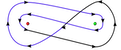
| + | Sometimes, we want to create our own metric space and transfer over properties. How these properties transfer over can be summarized by the following drawing (credits to Peng Zhou). | ||
| + | |||
| + | {{ math104-s21: | ||
| + | |||
| + | In this diagram there are two ways to create induced topology. We can either obtain the topology from an induced metric or from the old set itself. | ||
| + | |||
| + | One key idea to note is that (and I quote from course notes) **Given $A \subseteq S$ and (S, d) is a metric space, we can equip A with an induced metric. $E \subseteq A$ is open iff $\exists$ open set $ E_2 \subseteq S$ such that $E = E_2 \cap S$. From how a complement of an open set in ambient space is closed, we can use this theorem to tell alot topologically about the set.** | ||
| + | |||
| + | |||
| + | ==== Other Basic Topology | ||
| - A Set is ** countable ** iff there exists a one to one mapping between the elements of the set to the set of natural numbers. | - A Set is ** countable ** iff there exists a one to one mapping between the elements of the set to the set of natural numbers. | ||
| - An ** open ball ** (or neighborhood as referred to in Rudin), about point x and with radius r is $B(r; x) = \{y \in M: d(y, x) < r\}$ where (M, d) is the ambient metric space of x. | - An ** open ball ** (or neighborhood as referred to in Rudin), about point x and with radius r is $B(r; x) = \{y \in M: d(y, x) < r\}$ where (M, d) is the ambient metric space of x. | ||
| Line 190: | Line 209: | ||
| - $S$ is bounded iff $\exists r: \forall p, q \in S, d(p, q) \leq r$. | - $S$ is bounded iff $\exists r: \forall p, q \in S, d(p, q) \leq r$. | ||
| - $S$ is dense in $X$ iff every element in X is in $S$ or is a limit point of $S$. | - $S$ is dense in $X$ iff every element in X is in $S$ or is a limit point of $S$. | ||
| + | - $S$ is a perfect set iff $S$ is closed and $S$ does not have any isolated points. | ||
| - $diam(S)$, the diameter of $S$ is given to be $diam(S) = \sup_{x, y \in S} d(x, y)$. | - $diam(S)$, the diameter of $S$ is given to be $diam(S) = \sup_{x, y \in S} d(x, y)$. | ||
| ** E.g.: ** We can say that in the set $\{\frac{1}{n}: | ** E.g.: ** We can say that in the set $\{\frac{1}{n}: | ||
| - | === Useful results on Open Sets Closed Sets ==== | ||
| - | - A set is open iff its complement is closed. | ||
| - | - Given that $\bigcup S_i$ is a union of open sets, $\bigcup S_i$ is open. | ||
| - | - Given that $\bigcap S_i$ is the intersection of closed sets, $\bigcap S_i$ is closed. | ||
| - | - Given that $\bigcup S_i$ is a union of **finitely many** closed sets, $\bigcup S_i$ is closed. | ||
| - | - Given that $\bigcap S_i$ is the intersection of open sets, $\bigcap S_i$ is open. | ||
| Line 405: | Line 419: | ||
| In order to make an analog to the intermediate value theorem for continuous functions, we use make the following statement: | In order to make an analog to the intermediate value theorem for continuous functions, we use make the following statement: | ||
| - | ** Given that f is differentiable over $[a, b]$, $f'(a) < f' | + | ** Given that f is differentiable over $[a, b]$, $f'(a) < f' |
| One important thing to note here is that this ** does not result from the intermediate value theorem for continuous functions. ** Rather, it originates from the idea of global minima. The proof is very simple: | One important thing to note here is that this ** does not result from the intermediate value theorem for continuous functions. ** Rather, it originates from the idea of global minima. The proof is very simple: | ||
| - | Consider $g(x) = f(x) - \mu x$. We know $g'(a) = f'(a) - \mu < 0$ and $g'(b) = f'(a) - \mu > 0$. Now,since $[a, b]$ is compact, we know that there exists a global minimum for $f$. It cannot be $a, b$ since $f'(a) < 0, f'(b) > 0$ are nonzero. Therefore, we must say that the global minimum for $f$ must be $c \in (a, b)$. Since $f$ is continuous on $[a, b]$ it must be the case that $c$ is a local minimum as well. Thus, $f'(c) = 0$. | + | Consider $g(x) = f(x) - \mu x$. We know $g'(a) = f'(a) - \mu < 0$ and $g'(b) = f'(a) - \mu > 0$. Now,since $[a, b]$ is compact, we know that there exists a global minimum for $f$. It cannot be $a, b$ since $f'(a) < 0, f'(b) > 0$ are nonzero. Therefore, we must say that the global minimum for $f$ must be $x_0 \in (a, b)$. Since $f$ is continuous on $[a, b]$ it must be the case that $x_0$ is a local minimum as well. Thus, $f'(x_0) = 0$. |
| ==== L' | ==== L' | ||
math104-s21/s/ryotainagaki.1620849971.txt.gz · Last modified: 2026/02/21 14:44 (external edit)
Page Tools
Except where otherwise noted, content on this wiki is licensed under the following license: CC Attribution-Share Alike 4.0 International


