math104-s21:s:ryotainagaki
Differences
This shows you the differences between two versions of the page.
| Both sides previous revision Previous revision Next revision | Previous revision | ||
|
math104-s21:s:ryotainagaki [2021/05/12 08:37] 73.15.53.135 |
math104-s21:s:ryotainagaki [2026/02/21 14:41] (current) |
||
|---|---|---|---|
| Line 8: | Line 8: | ||
| 1. Sets and sequences. (Ch 1- 10 in Ross) \\ | 1. Sets and sequences. (Ch 1- 10 in Ross) \\ | ||
| 2. Subsequences, | 2. Subsequences, | ||
| - | 3. Compactness and Topology | + | 3. Topology (Ch 13 in Ross, Chapter 2 in Rudin) \\ |
| 4. Series (Ch 14) \\ | 4. Series (Ch 14) \\ | ||
| 5. Continuity, Uniform Continuity, Uniform Convergence (Chapter 4, 7 in Rudin)\\ | 5. Continuity, Uniform Continuity, Uniform Convergence (Chapter 4, 7 in Rudin)\\ | ||
| Line 27: | Line 27: | ||
| - | 1.1 Supremums and Infimums | + | ==== Supremums and Infimums |
| When you were probably 5 years old, you probably learned about what a maximum or minimum element of the set is. Such concepts seem clear cut; however, things get confusing when we introduce certain open sets (e.g. (-5, 5). | When you were probably 5 years old, you probably learned about what a maximum or minimum element of the set is. Such concepts seem clear cut; however, things get confusing when we introduce certain open sets (e.g. (-5, 5). | ||
| Line 37: | Line 37: | ||
| More mathematical way of putting this (supremum is sup and infimum is inf): | More mathematical way of putting this (supremum is sup and infimum is inf): | ||
| - | $$\sup S = x \iff (\forall s \in S, s \leq x) \land (\forall y < x, \exists s_b \in S: y < s_b < x)$$ | + | $$\sup S = x \iff (\forall s \in S, s \leq x) \land (\forall y < x, \exists s_b \in S: y < s_b \leq x)$$ |
| - | $$\inf S = x \iff (\forall s \in S, s \geq x) \land (\forall y > x, \exists s_b \in S: y > s_b > x)$$ | + | $$\inf S = x \iff (\forall s \in S, s \geq x) \land (\forall y > x, \exists s_b \in S: y > s_b \geq x)$$ |
| ** E.g.** | ** E.g.** | ||
| - | | + | |
| - | $$\inf \{x * y: x, y \in \{ 1, 2, 3, 4\}\} = 1$$. All elements in the set are greater than or equal to 1; hence making it an upper bound. Consider that for any z over 1 we always have an element in the set that is less than z, e.g. 1. This makes 1 a ** maximum lower bound ** of the set. | + | $$\inf \{x \cdot y: x, y \in \{ 1, 2, 3, 4\}\} = 1$$. All elements in the set are greater than or equal to 1; hence making it an upper bound. Consider that for any z over 1 we always have an element in the set that is less than z, e.g. 1. This makes 1 a ** maximum lower bound ** of the set. |
| ** E.g. ** | ** E.g. ** | ||
| Line 66: | Line 66: | ||
| $\frac{q_1}{q_2}$ where $q_1, q_2$ are two integer factors of $c_0$ and $c_n$ respectively. | $\frac{q_1}{q_2}$ where $q_1, q_2$ are two integer factors of $c_0$ and $c_n$ respectively. | ||
| - | ** 1.2 Sequences | + | ==== Sequences |
| A sequence is an ordered set of numbers/ | A sequence is an ordered set of numbers/ | ||
| $$\forall \epsilon > 0, \exists N > 0: \forall n > N, d(x_n, l) < \epsilon$$. As a sidenote, d is a metric of metric space M. (We'll go over metric spaces in Section 2, but when dealing with $\mathbb{R}^n$ d is the Cartesian distance function in $\mathbb{R}^n$. | $$\forall \epsilon > 0, \exists N > 0: \forall n > N, d(x_n, l) < \epsilon$$. As a sidenote, d is a metric of metric space M. (We'll go over metric spaces in Section 2, but when dealing with $\mathbb{R}^n$ d is the Cartesian distance function in $\mathbb{R}^n$. | ||
| Line 93: | Line 94: | ||
| - Division Rule (only if both numerator and denominator converge as $n \to \infty$. | - Division Rule (only if both numerator and denominator converge as $n \to \infty$. | ||
| - | ** Monotonically Increasing and Decreasing | + | ==== Monotonically Increasing and Decreasing |
| Although it may be redundant, I thought that it would be best to establish the definitions of monotonically increasing and decreasing. This will come in handy in the next subsection. | Although it may be redundant, I thought that it would be best to establish the definitions of monotonically increasing and decreasing. This will come in handy in the next subsection. | ||
| Line 124: | Line 125: | ||
| - | ** Subsequences | + | ==== Subsequences |
| We define a subsequence $s_{n_{k}}$ of $s_n$ as an ordered set of points in $s_n$ such that $\forall k \in \mathbb{N}, n_k < n_{k+1}$. | We define a subsequence $s_{n_{k}}$ of $s_n$ as an ordered set of points in $s_n$ such that $\forall k \in \mathbb{N}, n_k < n_{k+1}$. | ||
| Line 138: | Line 139: | ||
| ** E.g. ** Consider $x_n = (4)^{\frac{1}{n}}.$ Consider that $x_n = (4)^{\frac{1}{n}} = |4|^{\frac{1}{n}} = |a_n|^{\frac{1}{n}}$. Without using any complicated identities, $\lim |\frac{a_{n+1}}{a_n}| = \lim |\frac{4}{4}| = 1$. Applying the consequence from the previous " | ** E.g. ** Consider $x_n = (4)^{\frac{1}{n}}.$ Consider that $x_n = (4)^{\frac{1}{n}} = |4|^{\frac{1}{n}} = |a_n|^{\frac{1}{n}}$. Without using any complicated identities, $\lim |\frac{a_{n+1}}{a_n}| = \lim |\frac{4}{4}| = 1$. Applying the consequence from the previous " | ||
| - | ==== Section 3: Topology ==== | + | ===== Section 3: Topology |
| In order to generalize and make more precise the discussion on limits and later functions, we need to create a language with which to discuss domain, range, and sets. In pure math, not everything is in the set of real numbers. Therefore, we introduce the concepts of metric spaces, balls, and generalized notions of compactness and open sets. | In order to generalize and make more precise the discussion on limits and later functions, we need to create a language with which to discuss domain, range, and sets. In pure math, not everything is in the set of real numbers. Therefore, we introduce the concepts of metric spaces, balls, and generalized notions of compactness and open sets. | ||
| - | ** 3.1 Metric Spaces | + | ==== Metric Spaces |
| For most of our math lives up to Math 53, we have dealt with the cartesian space. We learned that distance between two points in 3d space is $d(x, y) = \sqrt{(x_0 - y_0)^2 + (x_1 - y_1)^2 + (x_2 - y_2)^2}$. Then in Math 54 (or in Physics 89) we met linear spaces in terms of vectors, functions, polynomials, | For most of our math lives up to Math 53, we have dealt with the cartesian space. We learned that distance between two points in 3d space is $d(x, y) = \sqrt{(x_0 - y_0)^2 + (x_1 - y_1)^2 + (x_2 - y_2)^2}$. Then in Math 54 (or in Physics 89) we met linear spaces in terms of vectors, functions, polynomials, | ||
| Line 183: | Line 184: | ||
| Therefore $E' = \emptyset$. And therefore $E = \overline{E}$ and thus $[0, 0.5]$ is closed. This illustrates that just because $E$ is open does not necessarily mean that it is not closed. | Therefore $E' = \emptyset$. And therefore $E = \overline{E}$ and thus $[0, 0.5]$ is closed. This illustrates that just because $E$ is open does not necessarily mean that it is not closed. | ||
| - | ** Other Definitions | + | ==== Useful results on Open Sets Closed Sets ==== |
| + | |||
| + | - A set is open iff its complement is closed. | ||
| + | - Given that $\bigcup S_i$ is a union of open sets, $\bigcup S_i$ is open. | ||
| + | - Given that $\bigcap S_i$ is the intersection of closed sets, $\bigcap S_i$ is closed. | ||
| + | - Given that $\bigcup S_i$ is a union of **finitely many** closed sets, $\bigcup S_i$ is closed. | ||
| + | - Given that $\bigcap S_i$ is the intersection of open sets, $\bigcap S_i$ is open. | ||
| + | |||
| + | ==== Induced Topology ==== | ||
| + | |||
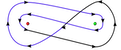
| + | Sometimes, we want to create our own metric space and transfer over properties. How these properties transfer over can be summarized by the following drawing (credits to Peng Zhou). | ||
| + | |||
| + | {{ math104-s21: | ||
| + | |||
| + | In this diagram there are two ways to create induced topology. We can either obtain the topology from an induced metric or from the old set itself. | ||
| + | |||
| + | One key idea to note is that (and I quote from course notes) **Given $A \subseteq S$ and (S, d) is a metric space, we can equip A with an induced metric. $E \subseteq A$ is open iff $\exists$ open set $ E_2 \subseteq S$ such that $E = E_2 \cap S$. From how a complement of an open set in ambient space is closed, we can use this theorem to tell alot topologically about the set.** | ||
| + | |||
| + | |||
| + | ==== Other Basic Topology Definitions ==== | ||
| - A Set is ** countable ** iff there exists a one to one mapping between the elements of the set to the set of natural numbers. | - A Set is ** countable ** iff there exists a one to one mapping between the elements of the set to the set of natural numbers. | ||
| - An ** open ball ** (or neighborhood as referred to in Rudin), about point x and with radius r is $B(r; x) = \{y \in M: d(y, x) < r\}$ where (M, d) is the ambient metric space of x. | - An ** open ball ** (or neighborhood as referred to in Rudin), about point x and with radius r is $B(r; x) = \{y \in M: d(y, x) < r\}$ where (M, d) is the ambient metric space of x. | ||
| Line 189: | Line 209: | ||
| - $S$ is bounded iff $\exists r: \forall p, q \in S, d(p, q) \leq r$. | - $S$ is bounded iff $\exists r: \forall p, q \in S, d(p, q) \leq r$. | ||
| - $S$ is dense in $X$ iff every element in X is in $S$ or is a limit point of $S$. | - $S$ is dense in $X$ iff every element in X is in $S$ or is a limit point of $S$. | ||
| + | - $S$ is a perfect set iff $S$ is closed and $S$ does not have any isolated points. | ||
| - $diam(S)$, the diameter of $S$ is given to be $diam(S) = \sup_{x, y \in S} d(x, y)$. | - $diam(S)$, the diameter of $S$ is given to be $diam(S) = \sup_{x, y \in S} d(x, y)$. | ||
| ** E.g.: ** We can say that in the set $\{\frac{1}{n}: | ** E.g.: ** We can say that in the set $\{\frac{1}{n}: | ||
| - | ** Useful results on Open Sets Closed Sets** | ||
| - | - A set is open iff its complement is closed. | ||
| - | - Given that $\bigcup S_i$ is a union of open sets, $\bigcup S_i$ is open. | ||
| - | - Given that $\bigcap S_i$ is the intersection of closed sets, $\bigcap S_i$ is closed. | ||
| - | - Given that $\bigcup S_i$ is a union of **finitely many** closed sets, $\bigcup S_i$ is closed. | ||
| - | - Given that $\bigcap S_i$ is the intersection of open sets, $\bigcap S_i$ is open. | ||
| - | ** Compactness | + | ==== Compactness |
| In a very abstract way, we can think of compact as the mathematical way of saying controlled, contained or small; to get a gist of what compactness mean, one may take some of the interesting analogies/ | In a very abstract way, we can think of compact as the mathematical way of saying controlled, contained or small; to get a gist of what compactness mean, one may take some of the interesting analogies/ | ||
| Line 223: | Line 238: | ||
| - Given that $\{C_{\alpha}\}$ is a collection of compact sets such that the intersection of any finite number of sets in the collection is nonempty, we know that $\bigcap C_{\alpha}$ is nonempty. | - Given that $\{C_{\alpha}\}$ is a collection of compact sets such that the intersection of any finite number of sets in the collection is nonempty, we know that $\bigcap C_{\alpha}$ is nonempty. | ||
| - | ** Connectedness | + | ==== Connectedness |
| We know that $A$ are connected iff we cannot write $A$ as a union of two disjoint open sets. | We know that $A$ are connected iff we cannot write $A$ as a union of two disjoint open sets. | ||
| Line 231: | Line 246: | ||
| E.g. On the other hand, $\mathbb{R}$ is a connected set. Suppose that I can write $\mathbb{R}$ as a union of disjoint sets. This inevitably leaves points missing from the $\mathbb{R}$. (Perhaps an exercise to prove). | E.g. On the other hand, $\mathbb{R}$ is a connected set. Suppose that I can write $\mathbb{R}$ as a union of disjoint sets. This inevitably leaves points missing from the $\mathbb{R}$. (Perhaps an exercise to prove). | ||
| - | ==== Section 4: Series ==== | + | ===== Section 4: Series |
| This section proceeds in a way similar to how we think of sequences; after all, we are working with indices and hence countable number of elements. We can think of $ \lim_{n \to | This section proceeds in a way similar to how we think of sequences; after all, we are working with indices and hence countable number of elements. We can think of $ \lim_{n \to | ||
| Line 286: | Line 301: | ||
| Some interesting things you can do with these series is to compute sums of the series. This can be done though things like Fourier Series or even using common McLaurin expansions of series. You may have seen these in some hard math 1b exams. | Some interesting things you can do with these series is to compute sums of the series. This can be done though things like Fourier Series or even using common McLaurin expansions of series. You may have seen these in some hard math 1b exams. | ||
| - | ==== Section 5: Continuity ==== | + | ===== Section 5: Continuity |
| This section of the course picks up from the 1-2 weeks in AP Calc BC that was dedicated to continuity. Back in that day, the domain of a real function is on the real line we know that f is continuous at $x_0$ iff $\lim_{x \to x_0^+}f(x) = \lim_{x \to x_0^-}f(x) = f(x_0)$. This made things very easy to prove. We also know that continuity, for granted, creates things like the intermediate value theorem and how if a function is differentiable then it is continuous. Now, once we start to deal with different metrics and less physically intuitive spaces (e.g. even hard-to-draw 3D space), we need to consider many more dimensions and nuances of continuity. This requires redefining/ | This section of the course picks up from the 1-2 weeks in AP Calc BC that was dedicated to continuity. Back in that day, the domain of a real function is on the real line we know that f is continuous at $x_0$ iff $\lim_{x \to x_0^+}f(x) = \lim_{x \to x_0^-}f(x) = f(x_0)$. This made things very easy to prove. We also know that continuity, for granted, creates things like the intermediate value theorem and how if a function is differentiable then it is continuous. Now, once we start to deal with different metrics and less physically intuitive spaces (e.g. even hard-to-draw 3D space), we need to consider many more dimensions and nuances of continuity. This requires redefining/ | ||
| - | ** Limits and The Many Ways to Say " | + | ==== Limits and The Many Ways to Say " |
| We can say that a function f has a limit of $l$ at p iff $(\forall p_n: p_n \to p), \to p, \lim f(p_n) = l$. I have to emphasize here $\forall p_n: p_n \to p$ since this is what makes it harder to show that a limit exists than it is to show that a limit doesn' | We can say that a function f has a limit of $l$ at p iff $(\forall p_n: p_n \to p), \to p, \lim f(p_n) = l$. I have to emphasize here $\forall p_n: p_n \to p$ since this is what makes it harder to show that a limit exists than it is to show that a limit doesn' | ||
| Line 306: | Line 321: | ||
| One thing to also note is how compactness is preserved through continuous functions. More precisely: given $X_2 \subseteq X$ is compact, we know that $f(X_2)$ is also compact. This is proven in Problem 1 of [[https:// | One thing to also note is how compactness is preserved through continuous functions. More precisely: given $X_2 \subseteq X$ is compact, we know that $f(X_2)$ is also compact. This is proven in Problem 1 of [[https:// | ||
| - | ** Uniform continuity | + | ==== Uniform continuity |
| $\forall \epsilon > 0: \exists \delta > 0: (\forall x_1, x_2 \in X), (d_X(x_1, x_2) < \delta) \longrightarrow (d_Y(f(x_1), | $\forall \epsilon > 0: \exists \delta > 0: (\forall x_1, x_2 \in X), (d_X(x_1, x_2) < \delta) \longrightarrow (d_Y(f(x_1), | ||
| Line 315: | Line 330: | ||
| - | ** Uniform continuity vs regular continuity | + | === Uniform continuity vs regular continuity |
| This is a TIGHTER condition when compared to regular continuity. | This is a TIGHTER condition when compared to regular continuity. | ||
| ** E.g. ** $f(x) = \frac{1}{x}$ on $(0, 1)$. (Probably a simple example from the Problem Book for Real Analysis). | ** E.g. ** $f(x) = \frac{1}{x}$ on $(0, 1)$. (Probably a simple example from the Problem Book for Real Analysis). | ||
| Line 326: | Line 342: | ||
| - If $S$ is a closed and compact subset of the domain of continuous function of $f$, we know that $f$ is uniformly continuous on $S$. | - If $S$ is a closed and compact subset of the domain of continuous function of $f$, we know that $f$ is uniformly continuous on $S$. | ||
| - | ** Uniform Convergence | + | ==== Uniform Convergence |
| Another interesting topic of continuity seems almost the same as the first parts of this course regarding sequences. However, we first change things by using continuous functions as elements in our sequence $f_n$. Secondly, we make sure that the end function that the sequence converges to $f_n$ is going to be so that $\forall \epsilon > \epsilon, \exists N: \forall n > N, d_Y(f_n(x), f(x)) < \epsilon$ for any x in the domain of $f$. | Another interesting topic of continuity seems almost the same as the first parts of this course regarding sequences. However, we first change things by using continuous functions as elements in our sequence $f_n$. Secondly, we make sure that the end function that the sequence converges to $f_n$ is going to be so that $\forall \epsilon > \epsilon, \exists N: \forall n > N, d_Y(f_n(x), f(x)) < \epsilon$ for any x in the domain of $f$. | ||
| Line 349: | Line 365: | ||
| - $(\forall \epsilon > 0, \exists N > 0: \forall m, n > N, |f_m(x) - f_n(x)| < \epsilon, \forall x \in X) \iff f_n \to f$ uniformly. This is the **Cauchy Criterion** for uniform convergence. | - $(\forall \epsilon > 0, \exists N > 0: \forall m, n > N, |f_m(x) - f_n(x)| < \epsilon, \forall x \in X) \iff f_n \to f$ uniformly. This is the **Cauchy Criterion** for uniform convergence. | ||
| - | ** Important results for Continuity | + | ==== Important results for Continuity |
| - Given that A is a connected subset of $X$ the domain of continuous function $f: X \to Y$, we know that $f(A)$ also has to be a connected set. | - Given that A is a connected subset of $X$ the domain of continuous function $f: X \to Y$, we know that $f(A)$ also has to be a connected set. | ||
| Line 373: | Line 389: | ||
| Therefore, I can say that there are at least 3 points $x_1, x_2, x_3$ in $\mathbb{R}$ such that $p(x_1) = 0 = p(x_2) = p(x_3)$. QED. | Therefore, I can say that there are at least 3 points $x_1, x_2, x_3$ in $\mathbb{R}$ such that $p(x_1) = 0 = p(x_2) = p(x_3)$. QED. | ||
| - | ==== Section 6: Derivatives ==== | + | ===== Section 6: Derivatives |
| - | ** Definition of derivative and differentiability: | + | ==== Definition of derivative and differentiability: |
| We know that $f$ is differentiable iff $\forall x \in \mathbb{R}, \lim_{h \to 0}\frac{f(x+h)-f(x)}{h}$ converges.That limit is known as the derivative of $f$. | We know that $f$ is differentiable iff $\forall x \in \mathbb{R}, \lim_{h \to 0}\frac{f(x+h)-f(x)}{h}$ converges.That limit is known as the derivative of $f$. | ||
| Line 386: | Line 402: | ||
| - | ** Mean Value Theorem | + | ==== Mean Value Theorem |
| The most well known form of the Mean Value Theorem tells us that if $f$ is real and continuous on $[x_1, x_2]$ and is differentiable on $(x_1, x_2)$, we know that $\exists x \in (x_1, x_2): f(x_2) - f(x_1) = (x_2 - x_1)f(x)$. We've seen alot of this in Math 1A type calculus. | The most well known form of the Mean Value Theorem tells us that if $f$ is real and continuous on $[x_1, x_2]$ and is differentiable on $(x_1, x_2)$, we know that $\exists x \in (x_1, x_2): f(x_2) - f(x_1) = (x_2 - x_1)f(x)$. We've seen alot of this in Math 1A type calculus. | ||
| Line 400: | Line 416: | ||
| Given real functions $f, g$ continuous over interval $[x_1, x_2]$ and differentiable over $(x_1, x_2)$. We know that $\exists x \in (x_1, x_2): (f(x_2) - f(x_1))g' | Given real functions $f, g$ continuous over interval $[x_1, x_2]$ and differentiable over $(x_1, x_2)$. We know that $\exists x \in (x_1, x_2): (f(x_2) - f(x_1))g' | ||
| - | ** L' | + | === Intermediate Value Theorems for Derivatives === |
| + | |||
| + | In order to make an analog to the intermediate value theorem for continuous functions, we use make the following statement: | ||
| + | ** Given that f is differentiable over $[a, b]$, $f'(a) < f' | ||
| + | |||
| + | One important thing to note here is that this ** does not result from the intermediate value theorem for continuous functions. ** Rather, it originates from the idea of global minima. The proof is very simple: | ||
| + | |||
| + | Consider $g(x) = f(x) - \mu x$. We know $g'(a) = f'(a) - \mu < 0$ and $g'(b) = f'(a) - \mu > 0$. Now,since $[a, b]$ is compact, we know that there exists a global minimum for $f$. It cannot be $a, b$ since $f'(a) < 0, f'(b) > 0$ are nonzero. Therefore, we must say that the global minimum for $f$ must be $x_0 \in (a, b)$. Since $f$ is continuous on $[a, b]$ it must be the case that $x_0$ is a local minimum as well. Thus, $f' | ||
| + | |||
| + | ==== L' | ||
| Given that $f, g: (a, b) \to \mathbb{R}$ are differentiable, | Given that $f, g: (a, b) \to \mathbb{R}$ are differentiable, | ||
| - $\lim_{x \to c} f(x) = \lim_{x \to c} g(x) = 0$ | - $\lim_{x \to c} f(x) = \lim_{x \to c} g(x) = 0$ | ||
| - | - $\lim_{x \to c} f(x) = \lim_{x \to c} g(x) = \pm \infty$ | + | - \lim_{x \to c} g(x) = \pm \infty$ |
| , then we can write $\lim_{x \to c}{\frac{f(x)}{g(x)}} = \lim_{x \to c}{\frac{f' | , then we can write $\lim_{x \to c}{\frac{f(x)}{g(x)}} = \lim_{x \to c}{\frac{f' | ||
| Line 419: | Line 444: | ||
| Thus make $c = 1$; that way $f$ is continuous at 0. | Thus make $c = 1$; that way $f$ is continuous at 0. | ||
| - | ** Taylor' | + | ==== Taylor' |
| Given a function f and its n-1 st order derivative that is continuous on on interval $[a, b]$, and given $\alpha, \beta \in [a, b]$, we know that $$f(\beta) = \sum_{i=0}^{n-1}\frac{f^{(i)}(\alpha) (\beta - \alpha)^i}{i !} + \frac{f^{(n)}(x)(\beta - \alpha)^n}{n!}$$ for some x between $\alpha$ and $\beta$. Notice that if I make $n=1$, Taylor' | Given a function f and its n-1 st order derivative that is continuous on on interval $[a, b]$, and given $\alpha, \beta \in [a, b]$, we know that $$f(\beta) = \sum_{i=0}^{n-1}\frac{f^{(i)}(\alpha) (\beta - \alpha)^i}{i !} + \frac{f^{(n)}(x)(\beta - \alpha)^n}{n!}$$ for some x between $\alpha$ and $\beta$. Notice that if I make $n=1$, Taylor' | ||
| Line 452: | Line 477: | ||
| - | ==== Section 7: Integrals ==== | + | ===== Section 7: Integrals |
| From Math 1A, we have all learned that the (kind-of and practical) antonym for differentiation is integration. In this case, we have also learned that integrals are really just a sum of many rectangles. In this subpart of analysis, we formalize and generalize this intuition even further. | From Math 1A, we have all learned that the (kind-of and practical) antonym for differentiation is integration. In this case, we have also learned that integrals are really just a sum of many rectangles. In this subpart of analysis, we formalize and generalize this intuition even further. | ||
| Line 461: | Line 486: | ||
| - | ** Riemann Integrals | + | ==== Riemann Integrals |
| We use the riemann integral to be defined as follows: | We use the riemann integral to be defined as follows: | ||
| $\int_{a}^{b}f(x)dx = \lim_{n \to \infty}\sum_{i=0}^{n}f(s_i)\triangle x_i$ where $\triangle x_i = x_{i+1} - x_{i}$ where $x_{i-1} < x_{i}$ and both are consecutive points in the Riemann sum and where $s_i$ is a point in $[x_{i}, x_{i+1}]$. $x_0, x_1, ... ,x_n, x_{n+1}$ are points in partition P of $[a, b]$ and $x_0, x_{n+1}$ are a and b, respectively. | $\int_{a}^{b}f(x)dx = \lim_{n \to \infty}\sum_{i=0}^{n}f(s_i)\triangle x_i$ where $\triangle x_i = x_{i+1} - x_{i}$ where $x_{i-1} < x_{i}$ and both are consecutive points in the Riemann sum and where $s_i$ is a point in $[x_{i}, x_{i+1}]$. $x_0, x_1, ... ,x_n, x_{n+1}$ are points in partition P of $[a, b]$ and $x_0, x_{n+1}$ are a and b, respectively. | ||
| Line 472: | Line 497: | ||
| This seems pretty basic, but integrals can be generalized and studied even further through the Stieltjes integral. There we use a $d \alpha$. | This seems pretty basic, but integrals can be generalized and studied even further through the Stieltjes integral. There we use a $d \alpha$. | ||
| - | ** Stieltjes Integral** | + | ==== Stieltjes Integral |
| Let $\alpha$ be a monotonically increasing function. We denote our Stieltjes integral over $[a, b]$ through the following. | Let $\alpha$ be a monotonically increasing function. We denote our Stieltjes integral over $[a, b]$ through the following. | ||
| Line 503: | Line 528: | ||
| - | **More Useful Properties** | + | ==== More Useful Properties |
| **More on Refinements** | **More on Refinements** | ||
| Line 531: | Line 556: | ||
| - | ** Fundamental Theorem of Calculus | + | ==== Fundamental Theorem of Calculus |
| In order to connect derivatives, | In order to connect derivatives, | ||
| Line 546: | Line 571: | ||
| All that is left in this course is some detail about the uniform convergence of integrals and derivatives.... | All that is left in this course is some detail about the uniform convergence of integrals and derivatives.... | ||
| - | ** Uniform Convergence of integrals and derivatives | + | ==== Uniform Convergence of integrals and derivatives |
| We know that generally if $f_n \to f$ uniformly and $f_n$ is integrable (whether Riemann integrable or with respects to some increasing function $\alpha$), then f is also integrable. | We know that generally if $f_n \to f$ uniformly and $f_n$ is integrable (whether Riemann integrable or with respects to some increasing function $\alpha$), then f is also integrable. | ||
math104-s21/s/ryotainagaki.1620808667.txt.gz · Last modified: 2026/02/21 14:44 (external edit)
Page Tools
Except where otherwise noted, content on this wiki is licensed under the following license: CC Attribution-Share Alike 4.0 International


